It was very cold yesterday, not as cold as today where our thermometer registers only 10 below, but cold nonetheless at about 8 above zero. Still it was sunny and lovely, so we decided to take a hike.
At least once per year, especially in the winter, I want to take a hike to the 'Lost Forty' in order to see the spread of 'Princess Pines'. Princess Pine is the common name for this beautiful, tiny, pine-tree-looking plant. They are somewhat rare and in no other place that we have hiked have we seen them.
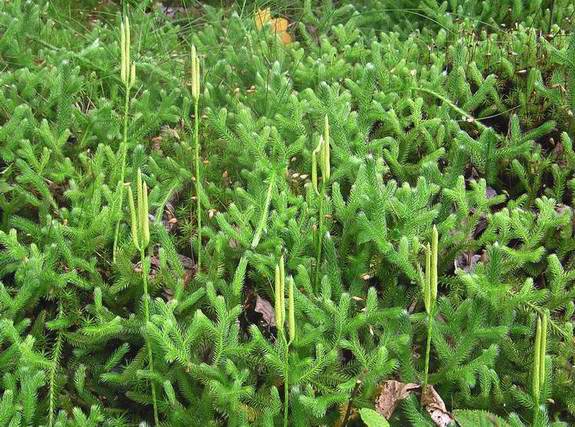
"Common Name: Club Moss, Running pine, Staghorn club moss, Wolf claw club moss, Ground pine, Running moss, Princess pine - The common name describes the club-like appendages at the end of a long stalk that extends upward from the moss-like basal plant, the overall effect is a moss with clubs.
Scientific Name: Lycopodium clavatum - The generic name
is from the Greek words lukos meaning wolf and podos
meaning foot; the tips of the branches are reminiscent of a wolf paw. The specific
name is from the Latin clava meaning club which accentuates the
club-like extensions.
Club mosses are the vestigial relict of the earliest land plants which
evolved in the Devonian Period about 395 million years ago. Members of this
group of plants included tree lycopods of the extinct genus Lepidodendron
that were up to 100 feet in height whose deposition and decay during the
Carboniferous Period engendered the world's major coal fields. The club moss
is not a moss since it is vascular; mosses are non-vascular bryophytes.
Botanically, vascular refers to the evolution of specialized xylem and phloem
cells that provide for the fluid transfer necessary for nutrient provisioning
and sufficient for complex structure. Club mosses are often referred to in
the vernacular literature as lycophytes or lycopsids in reference to earlier
taxonomies that placed them in the divisions Lycophyta and Lycopsida, now in
desuetude due to the revelations of DNA associations. Club mosses are now
generally grouped in a separate class, Lycopodiopsida.
The life cycle of the club mosses, like that of the ferns, is a combination of
a spore producing phase (sporophyte) and a sexual phase (gametophyte), an
arrangement that appears to mark a transitional phase in the evolution of
plants. The cycle nominally starts when a single spore among the billions
produced successfully germinates and forms one of two different pre-sexual
bodies called prothalli. While some prothalli are photosynthetic and epigeal,
growing on top of the soil, most are hypogeal, buried by accumulated debris
or faunal motive activity to depths of up to 4 inches." (Excerpted from The Hikers Notebook, to access online go to: http://www.sierrapotomac.org/W_Needham/ClubMoss_040110R090318.htm)

We started our hike uphill wending our way through all of the tree-fall from Freddie's hillside cut last winter...it was not easy, but did keep us warmed up.

We are within the 'Lost Forty' approaching the Princess Pines.

It is truly a lovely spot and feels quite magical.

I was sufficiently bundled up against the temperature, and except for my hands getting cold when I took photos, I stayed plenty warm.

These miniature 'pines' are slowly spreading, and each time we come to this spot, they have multiplied, though not in huge amounts. They appear undamaged year after year, and we have a tendency to keep this location secret, in order to keep them that way.
It definitely was a cold day, however it was both physically and mentally invigorating. The hour and a half hike proved to be a spiritual renewal!!
It definitely was a cold day, however it was both physically and mentally invigorating. The hour and a half hike proved to be a spiritual renewal!!

1 comment:
Oh how exciting and that's what I miss about Southwest Wisconsin....those little ecological treasures. Good idea to keep the location quiet.
Glad you and Freddie got out for a hike today. Our high temp never got above -7 degrees.
Post a Comment